Thyroid & Neck
Sound Imaging provides thyroid and neck ultrasounds in Anchorage and Soldotna, Alaska. Our sonographers use detailed ultrasound images to evaluate thyroid nodules, an enlarged thyroid, and changes associated with thyroid conditions such as Hashimoto’s thyroiditis or Graves’ disease.
A neck ultrasound can assess lumps, swelling, enlarged lymph nodes, parathyroid glands, and salivary glands. Your provider may order an ultrasound to investigate a neck lump, difficulty swallowing, or suspected thyroid changes, or to monitor you after thyroid cancer treatment. Contact Sound Imaging to book your appointment.

Understanding Your Thyroid and Neck Ultrasound
A thyroid and neck ultrasound provides important information about your thyroid gland, parathyroid glands, lymph nodes, and other structures in your neck. At Sound Imaging, a thyroid ultrasound can help your healthcare provider check your thyroid health and find changes early.
A thyroid ultrasound shows things a physical exam or thyroid blood test can’t. These images can find and measure thyroid nodules, check an enlarged thyroid (goiter), and look at swollen lymph nodes and neck lumps. They help your provider understand your symptoms, decide whether a nodule needs a biopsy and make informed decisions about your care.


Depending on your symptoms and the reason for your exam, a thyroid and neck ultrasound may be used to:
- Find, measure and monitor thyroid nodules
- Check an enlarged thyroid or goiter
- Look for changes from Hashimoto’s thyroiditis or Graves’ disease
- Follow up on abnormal thyroid blood tests
- Check a lump or swelling in the neck
- Look at enlarged or abnormal lymph nodes
- Help find overactive parathyroid glands
- Provide more imaging when your healthcare provider recommends it
Different Thyroid and Neck Ultrasounds
Thyroid Ultrasound
A thyroid ultrasound checks the size, shape and texture of your thyroid gland. It is often the first imaging test for abnormal thyroid blood tests, an enlarged thyroid or a lump found during a physical exam.
Thyroid Nodule Ultrasound
A thyroid nodule ultrasound measures and describes any nodules in your thyroid. Most thyroid nodules are harmless, and ultrasound features help your provider decide whether a nodule can be monitored or needs a biopsy.
Thyroid Nodule Follow-Up Ultrasound
A thyroid nodule follow-up ultrasound compares your nodules with earlier scans. It checks whether they have grown or changed, so your provider can keep watching them over time without unnecessary procedures.
Goiter Ultrasound
A goiter ultrasound measures an enlarged thyroid and checks whether it is smooth or made up of many nodules. It can help explain neck swelling, a tight feeling in the throat or trouble swallowing.
Thyroiditis Ultrasound
A thyroiditis ultrasound looks for changes in the thyroid tissue caused by inflammation. It can show patterns seen with Hashimoto’s thyroiditis and Graves’ disease, supporting your blood test results and diagnosis.
Parathyroid Ultrasound
A parathyroid ultrasound looks for an enlarged parathyroid gland, called a parathyroid adenoma. It is often ordered for high calcium levels and helps your surgeon plan treatment for hyperparathyroidism.
Neck Lymph Node Ultrasound
A neck lymph node ultrasound checks swollen or enlarged lymph nodes. It can show whether nodes look reactive from an infection or have features that need follow-up or a biopsy.
Neck Mass Ultrasound
A neck mass ultrasound looks closely at a lump or swelling in the neck. It can show whether the lump is a cyst, a lymph node, a thyroid nodule or another type of mass, helping your provider decide on next steps.
Salivary Gland Ultrasound
A salivary gland ultrasound checks the glands under your jaw and in front of your ears. It can find salivary stones, swelling, infection or growths that cause pain or swelling when eating.
Thyroid Cancer Surveillance Ultrasound
A thyroid cancer surveillance ultrasound is done after thyroid cancer treatment. It checks the thyroid bed and neck lymph nodes for any signs that the cancer has returned, as part of your long-term follow-up care.
Ultrasound-Guided Thyroid Biopsy
An ultrasound-guided thyroid biopsy, also called a fine needle aspiration (FNA), uses live imaging to guide a thin needle into a thyroid nodule or lymph node. A small sample of cells is taken for testing, usually with little discomfort and no recovery time.

What to Expect
Before your Appointment
-
Your preparation may vary depending on the type of thyroid or neck ultrasound you are having. When you schedule your appointment, our staff will let you know about any special instructions. For most thyroid and neck ultrasounds, no special preparation is needed.
- Eat, drink and take your medicine as usual, including thyroid medicine.
- No fasting or full bladder is needed.
- Wear a shirt with an open or low neckline. Avoid turtlenecks and high collars.
- Leave necklaces and earrings at home, or plan to remove them before your exam.
- Bring earlier thyroid ultrasound reports if they were done somewhere else. This helps the radiologist compare nodules over time.
- For an ultrasound-guided thyroid biopsy: Tell our staff if you take blood thinners, such as aspirin, warfarin or Eliquis. Do not stop any medicine unless your provider tells you to.
When You Arrive
- Our team will check you in and guide you to the ultrasound room. Your sonographer will explain the exam and help you get comfortably positioned before the study begins.
During Your Ultrasound
-
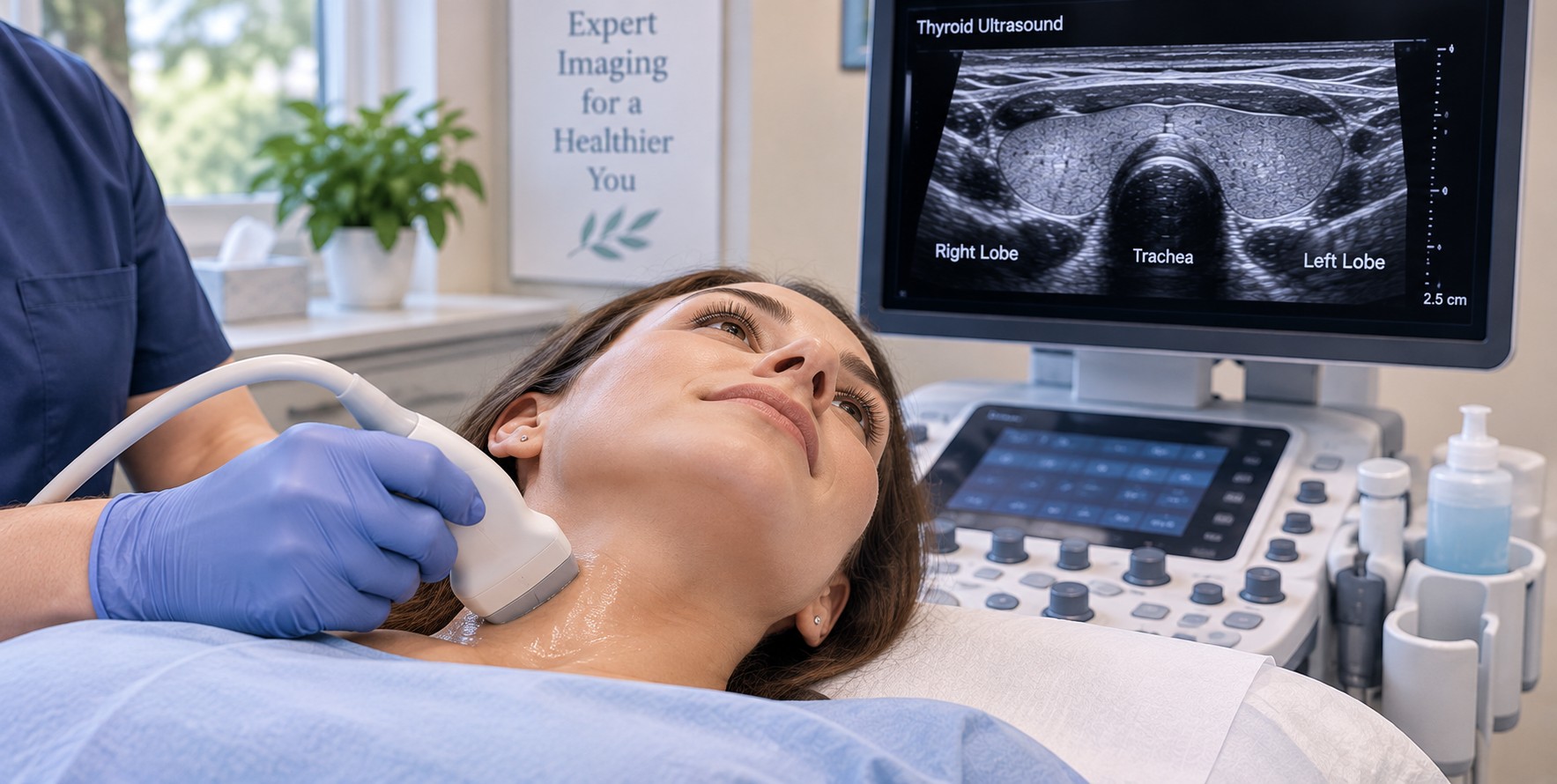
A registered sonographer will bring you to a private exam room and have you lie on your back on the exam table. A small pillow or rolled towel may be placed under your shoulders so your head tilts back slightly. This stretches your neck and gives a clear view of your thyroid.
-
Your sonographer will apply warm gel on your neck and gently move a small handheld transducer over the front and sides of your neck. Most patients feel only light pressure. You may be asked to swallow or turn your head to one side so your thyroid, lymph nodes, and other structures can be seen from different angles.
How Long Will It Take?
- Most thyroid and neck ultrasounds take 20 to 30 minutes. A parathyroid ultrasound or a full neck lymph node evaluation may take a little longer. An ultrasound-guided thyroid biopsy usually takes 30 to 60 minutes, including preparation.
After Your Exam
-
There is no recovery time after a thyroid ultrasound. The gel wipes off easily, and you can eat, drive and return to your normal activities right away.
-
After a thyroid biopsy, you may have mild soreness or a small bruise on your neck for a day or two. Most patients return to normal activities the same day. Your care team will give you aftercare instructions.
Getting Your Thyroid Ultrasound Results
- A radiologist will review your thyroid and neck images and send a report to your healthcare provider, usually within a few business days. If thyroid nodules are found, the report will describe their size and features. It often includes a TI-RADS score, which helps your provider decide whether a nodule can be monitored or needs a biopsy. Your provider will contact you to explain your results and talk about next steps, such as follow-up ultrasounds, a biopsy or a referral to an endocrinologist. Your sonographer is not able to share results during the exam.
FAQ
Do I need to fast before a thyroid ultrasound?
No. You can eat, drink and take your usual medicine, including thyroid medicine, before your exam.
Does a thyroid ultrasound hurt?
No. Most patients feel only light pressure from the transducer on the neck. Tilting your head back may feel a little awkward, but it should not be painful.
Are thyroid nodules common?
Yes. Thyroid nodules are very common, especially as people get older, and most are noncancerous. A thyroid ultrasound helps your provider tell which nodules need closer attention.
What is a TI-RADS score?
TI-RADS is a scoring system radiologists use to describe thyroid nodules based on their ultrasound features. A higher score means a nodule has more features that may need a biopsy or follow-up.
How often do thyroid nodules need to be checked?
It depends on the size and features of your nodules. Many nodules are rechecked with a follow-up thyroid ultrasound every 1 to 2 years, or as your provider recommends.
Is a thyroid ultrasound safe?
Yes. Ultrasound uses sound waves instead of radiation and is safe for adults, children and pregnant patients.
Insurance
Sound Imaging is in network with
Aetna
Blue Cross
Cigna
Meritain Health
Moda Health
TriWest
UnitedHealthcare
Alaska Medicaid including Denali KidCare
Medicare (coming soon)
Coverage and benefits vary by individual insurance plan. Questions about your coverage? Call (907) 531-2726.
No Surprise Act
Public Health Service (PHS) Act 2799B-3 and Section 45 of the Code of Federal Regulations (CFR) 149.430, describe medical consumer legal protections known as the No Surprise Act (NSA).
If you have an emergency medical condition and get emergency services from an out of network provider or facility, the most the provider or facility may bill you is your plan’s in network cost-sharing amount (such as copayments and coinsurance). You can’t be balance billed for these emergency services.
No Surprise Act Good Faith Estimates
Upon request, we are happy to provide registered patients with a good faith estimate based upon physician prescribed services, which will include expected charges for items or services as published in our current standard fee schedule. The estimate is based on information known at the time the estimate was created. The Good Faith Estimate does not include any unknown or unexpected costs that may arise during treatment. You could be charged more if complications or special circumstances occur.